

Finance teams have spent two decades building a governance practice they can defend. Business operations teams have spent the same two decades with very little.
This becomes a problem the moment ops starts deploying AI.
Most operations leaders are working without a prescription. There's no SOX-equivalent for marketplace operations or supply chain monitoring. ISO 9001 and SOC 2 cover the controls around the system, not the analytical decisions the system makes day to day. When something goes wrong inside an ops AI workflow, there isn't a manual to point to.
Three patterns keep showing up in our customer conversations. An agent surfaces an anomaly affecting a region the operator doesn't actually have authority over, and the alert lands with the wrong person. A workflow gets updated by a well-meaning analyst on a Tuesday, and the new logic produces different results than the version that ran last quarter, with no record of the change. An account manager runs a merchant performance analysis on partners outside their territory, because nobody put a fence around the agent.
These aren't actually AI failures. They're governance failures, and they happen because nobody told ops what governance was supposed to look like.
This piece is meant to fix that, or at the very least make you aware of it.
These aren't actually AI failures. They're governance failures.
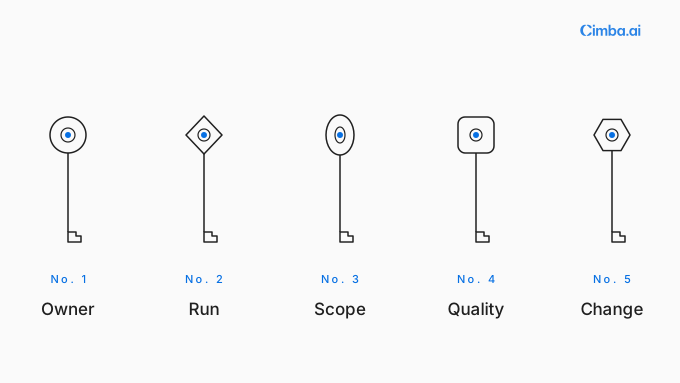
The five questions that define a governed AI workflow
Let's ignore the regulatory framing for a minute. AI governance for operations comes down to five practical questions you should be able to answer every time you deploy a workflow.
Five questions that govern an AI workflow
- 1Owner. Who is the named human accountable for this workflow?
- 2Run. Who is allowed to execute it, and how is that scope enforced?
- 3Scope. What data can it read, what systems can it write to, what actions can it take without human approval?
- 4Quality. How do we know the answers are still right over time?
- 5Change. What happens when the logic needs to be updated?
If you can answer all five with a name, a rule, or a documented process, the workflow is governed. If any answer is “we'll figure it out later,” it isn't yet. Most ops AI deployments fail at least two of these on day one. The gap between the two columns below is exactly what a governed workflow closes.
| The question | Ungoverned workflow | Governed workflow |
|---|---|---|
| Who can act | Anyone with the login, no scope enforced | A named owner, role-based access set at the data layer |
| What is logged | Nothing, or scattered screenshots | Every step, assumption, and output, append-only |
| Proving what happened | Reconstruct it from memory after the fact | Read the audit trail for that exact run |
| Access control | “We trained people not to misuse it” | Enforced by role, SOC 2 Type II |
| Reversibility | Hope someone kept a copy of the old logic | Versioned and reversible, prior runs reproducible |
What each question actually means
The first two are about people. Every agent has one named owner who can be paged when the workflow misfires. Not a team alias, not “the analytics group,” a person. And run permissions for AI agents should mirror the access patterns you already use for systems of record. A regional ops manager has a region. An account manager has a territory of merchants. An inventory analyst owns a category of SKUs. A merchant operations team has a market segment. The agent's scope should follow the same lines, enforced at the data layer rather than at the UI. The shortcut “we'll just train people not to misuse it” creates the same exposure that produces SOX deficiencies in finance, and it doesn't scale.
Access isn't binary. It's bounded
Illustrative example.
Regional ops manager
- Delivery SLA·Pacific NW region
Account manager
- Merchant performance·merchants in territory
- Pricing scenarios·deals in territory
Inventory analyst
- Stock-out forecast·category owned
- Pricing scenarios·category owned
Merchant ops lead
- Merchant performance·segment
Each cell shows the scope of access, not just whether access exists.
The third question is about capability. For each agent, write down what data it can read, what systems it can write to, and which actions it can take without human approval. This is a one-page document. It exists for every agent. The closer the workflow gets to taking direct action in a system of record, the more controls it needs around it. An agent that flags a delivery SLA breach lives under a different governance bar than one that automatically reroutes a shipment. This is where the Next Best Action model earns its place: Cimba recommends the action and attaches its projected impact, a named human approves it, and only then does Cimba execute. Human-in-the-loop is not a setting you turn on later, it is the shape of the workflow.
The fourth is about quality over time. Logic that was correct in June can drift by September, and nobody tells you when it does. Set up a recurring check, monthly or quarterly depending on stakes, where someone with domain knowledge looks at a sample of recent runs and confirms the agent is still producing reasonable answers. It's not heavy work. Think of it as the AI equivalent of the access review your security team already runs.
The fifth is about change. When the logic of a workflow changes, the change is logged, the version is preserved, and the people who depend on the workflow know about it before it ships. The fix is to treat workflow logic the way you'd treat a SQL view that other systems depend on. Iterate freely in development. Promote to production through review. Anything else turns analyst velocity into auditor liability.
Ungoverned
No owner, no record
Governed
Named owner, every step logged
Audit by design is what lets ops say yes
Governance usually reads as a tax on speed. Done right, it's the opposite: it's what lets an ops or finance team approve an AI action instead of routing it through a committee. When every step, assumption, and output is logged to an append-only audit trail, access is enforced by role, and a human approves before anything executes, the people who have to sign off can actually see what happened. That is what audit by design means, and it is why compliance says yes rather than not yet.
The record isn't a separate spreadsheet you reconcile later. It is the run itself. A close workflow, an approval, a flagged anomaly, each one lands in the same trail, with who did it and when:
Audit TrailFinance ops2m ago18m ago1h ago3h agoThe same trail is what turns governance into a return you can point to. Because each action is logged against the outcome it produced, the case for the workflow isn't hours saved on a slide, it's revenue you can attribute. Take an illustrative Next Best Action from delivery ops: pickup times in one zone drift 14 minutes past target, courier supply is 12% under forecast at three merchants, Cimba recommends reassigning six couriers before the 12:00 peak, the city ops lead approves from Slack, and about 38 late orders and $3.4k in SLA credits are saved that shift, all logged against that exact action. One measured action, compounded across hundreds a week, is how operations teams reach +20% revenue per customer. The audit trail is what makes that number defensible rather than a claim.
Where to start tomorrow
If you read this and realized your ops AI doesn't meet most of these standards, you're in the same boat as almost everyone deploying AI in operations right now. The fix takes a week, not a quarter.
A two-week starting plan
Pick your three highest-impact AI workflows. For each, name an owner, write a one-page scope document, and set the access rules in the data layer.
Add a quarterly validation review and a change-control process for workflow updates.
Ops governance won't ever be SOX, and it doesn't have to be. The bar is more practical. A practice someone in the room can defend, and a record someone outside the room can audit. That's it. That's the bar.
Cimba is proactive AI for enterprise business and finance operations. If you're rolling out AI in operations and want governance that ships at the same speed as the workflow, book a demo.
Evaluating enterprise AI?
Ask us the hard questions.