

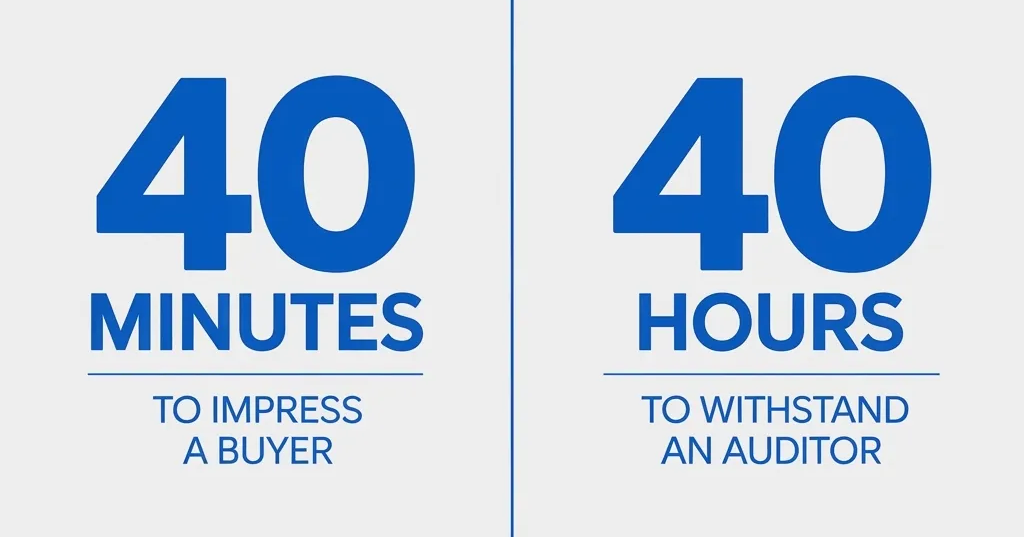
Most enterprise AI was designed to impress a buyer in forty minutes, not to withstand an auditor for forty hours. That's the design error you can't retrofit.
You can see the order of operations in almost any enterprise AI pitch from the last eighteen months. Forty minutes of demo. Fifteen minutes of roadmap. Then, near the end, a slide labeled “Security & Compliance” with a few logos, a line about SOC 2, and a promise that audit trails are “on the roadmap.” Governance shows up the way legal disclaimers show up in a prescription drug commercial. Fast, quiet, at the end.
That order of operations is the problem.
Most enterprise AI tools were built to be impressive first and trustworthy later. The demo had to land, so governance got pushed to the next release. Audit trails, role-based access, data lineage, approval workflows. All of it was pushed to a second release or a procurement conversation. Something to worry about once the interesting engineering and “magic” of AI was done.
That worked fine when AI was a sandbox. It doesn't work when the output has to survive an audit.
Most enterprise AI was designed to impress a buyer in forty minutes, not to withstand an auditor for forty hours.
Governance is what makes AI usable for decisions that matter
If your AI can't answer the question “how did you arrive at this answer, who approved this logic, and who can run this workflow,” then it can't be used for anything that actually matters. Not close or forecasting or risk monitoring. Not anything that touches a control. That's the part most vendors won't say.
Governance isn't a tax on speed. It's the thing that lets speed count.
The clearest way to see the difference is to put the two answers side by side. One arrives as a number you have to take on faith. The other shows its work: the data it read, the business logic it applied, every step logged, and a run you can reproduce next quarter.
Black box
A demo-grade answer you can't trace
Show your work
Every step logged, reproducible
A proactive workflow that surfaces a variance in the wrong account and routes it to the wrong person is worse than no workflow at all. An anomaly flagged without an audit trail doesn't reduce risk, it moves it. Ops and finance teams weren't slow to adopt AI because they were conservative. They were slow because they'd seen too many pilots that couldn't survive a real audit conversation.
When governance arrives as a retrofit, a predictable sequence plays out.
1
Rework
The logs weren't designed for audit, so they get reverse-engineered under pressure.
2
Shadow process
Teams can't fully trust the AI, so a parallel human review emerges that cancels the productivity gain.
3
Program shelved
Finance or legal eventually pulls the plug.
This isn't hypothetical. This is what retrofit governance looks like in practice.
The design choice that has to come first
The alternative isn't about slowing down. You just start somewhere different.
When you design an AI platform around governance from day one, a lot of decisions get easier. This is how Cimba is built. Every step a workflow takes is logged because the system assumes everything will be logged, not because a compliance officer eventually filed a ticket. Governance and guardrails live in the data model, so role-based access and approvals are decided up front, not bolted on. Answers are grounded in your live data and your own definitions through the Adaptive Context Graph, not a generic model guess. Execution is deterministic by design: governed, deterministic workflows produce the same trusted outcome each cycle instead of a different path each run. Explainability is how the product works, not a modal window that appears when someone clicks “why.” And it holds up to outside scrutiny: SOC 2 Type II, deployable as SaaS or in your own cloud or VPC, so the data never has to leave your infrastructure.
We call this audit by design. Not a pillar next to speed or intelligence. The thing the rest of the house sits on. Put the two postures next to each other on the questions an auditor actually asks:
| The question an auditor asks | Demo-grade AI | Audit-by-design AI |
|---|---|---|
| Can you trace this answer? | Not without reverse-engineering it | Every source and step is on the run |
| Is every step logged? | Logging was a later ticket | Append-only by default, explainable |
| Does it apply our business logic? | Generic model output | Your definitions, the same trusted way every run |
| Who can see and do what? | Added after deployment, if at all | Role-based access, built into the data model |
| Will it survive an auditor? | A slide that says SOC 2 | SOC 2 Type II, walked step by step in the room |
Auditability isn't paperwork. It's what lets the work be acted on. When an operator can see the data Cimba read, the business logic it applied from the Adaptive Context Graph, and every step it logged, they can trust the recommendation enough to approve it and let Cimba execute. That is the whole point of the Next Best Action Agent: a specific recommended move, its projected impact attached, routed to the person who can approve it, with a human in the loop before anything runs. Governance is what turns a flagged anomaly into an action someone is willing to sign.
Every governed run leaves a record of exactly that, its work shown end to end:
variance_reportQ3 budget review · Run #21208:41:0708:41:2208:42:1008:44:5308:45:09It changes what you can measure, too. Because every action is logged against the outcome it produced, the return shows up in the top line, not a sentiment survey. Not just hours saved, revenue you can attribute. In one illustrative run, pickup times in a delivery zone drift 14 minutes past target, Cimba traces it to courier supply running 12% under forecast at three merchants, recommends reassigning six couriers before the noon peak, the city ops lead approves from Slack, and the shift ends with 38 late orders avoided and about $3.4k in SLA credits saved, all logged against that one action.
One measured action, compounded across hundreds a week, is how operations teams reach a real number, on the order of +20% revenue per customer. None of that is possible if you can't audit the work. Meanwhile, the teams using retrofit AI are still in their third meeting about how to extract usable logs from a tool they deployed last year.
What this means for the next twelve months
Every enterprise AI buyer is about to make a decision they'll live with for years. Most of them are being shown demos optimized for the first three minutes of a conversation. Very few are being shown what governance actually looks like when it isn't a feature.
Four questions to ask any AI vendor
Ask the harder questions early.
- 1What gets logged, by default, and what doesn't?
- 2Who can run which workflow, and where is that rule defined?
- 3How do you demonstrate consistency across runs?
- 4What does "audit by design" actually mean inside this product, and can you show me without a slide?
If the answer to any of those is “we're working on it,” the platform isn't ready for a decision you can't walk back.
At Cimba, we think governance isn't the last thing you add to enterprise AI. It's the first thing you design for. Proactive, auditable, consistent, trusted, in that order (we call this “PACT” and it will be a recurring theme for us). If you get the auditable part wrong, the rest of it doesn't matter.
Cimba is proactive AI for enterprise business and finance operations. If you're evaluating AI for work that has to survive an audit, book a demo.
Evaluating enterprise AI?
Ask us the hard questions.