

A couple of years ago, the analytics agent felt like magic. You typed a question in plain English, and instead of filing a ticket with the BI team and waiting three days, you got a chart back in seconds. “Show me last quarter’s revenue by region.” “Which merchants slowed down last month.” No SQL, no waiting, no analyst in the middle.
That was a real step forward, and it is worth saying so plainly. The analytics agent took the queue that used to pile up in front of every data team and cleared it. It gave a lot of people direct access to answers they used to have to ask someone else for. If your problem was “I cannot get to my own data without help,” it solved that.
But it has a ceiling, and most teams have now hit it.
An answer is not an action
Here is the ceiling. The analytics agent stops at the answer. It tells you what happened. Then it hands the chart to a human, and everything that actually changes the business happens after that: someone has to read the chart, work out what it means, decide what to do, and then go do it across whatever tools the work lives in.
The chart was never the point. The hard part, the part that was always hard, is the distance between knowing something and doing something about it. Analytics agents made the first half nearly free and left the whole second half exactly where it was.
So you end up with a faster version of the same problem. You can ask “which merchants slowed down last month” and get an instant answer. But you still have to notice it, decide which slowdowns actually matter, figure out the why part of the question, the next action to take, and carry it out. The agent gave you a quicker report. It did not recommend what you should do next.
Analytics agent
Stops when the answer is delivered
Next Best Action agent
Starts where the answer arrives
What a Next Best Action agent does instead
A Next Best Action agent starts where the analytics agent stops. This is proactive AI: the AI comes to you instead of you going to the AI.
It does not wait to be asked. It watches the business, notices what matters, and instead of returning a chart, it returns a decision: here is what is happening, here is what to do about it, and here is why. That starts with a notification the moment something needs attention, not a chart waiting to be pulled. Where it is allowed to, it does the thing itself. Where a human should sign off, it surfaces the recommendation with the reasoning attached, ready to approve. It then watches the action that was taken and attributes the change back to it, improving the business outcome in a closed-loop system.
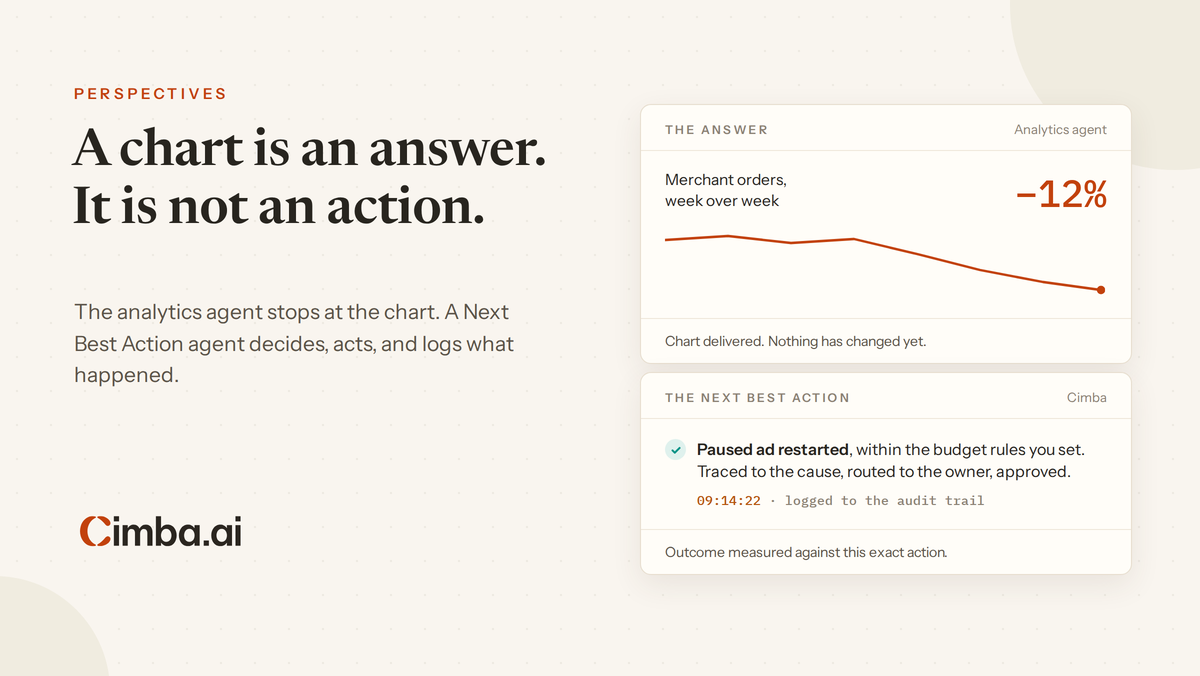
Put the two side by side in the same situation. A merchant’s orders drop 12% week over week.
The analytics agent waits for someone to ask, then confirms the drop and, if pressed, points at a likely cause. You now know something is wrong. The work of deciding and acting is still yours.
The Next Best Action agent catches the drop on its own, traces it to the paused ad behind it, and either restarts the ad within the budget rules you set or puts that exact recommendation in front of the account manager to approve, flagging it the moment it happens rather than waiting on a query. You now have a decision, not a data point.
By the time the analytics agent’s chart gets read, the merchant has had a week of depressed orders no one recovered. That week is the cost of stopping at the answer.
Merchant health · Next Best Action
Executed09:02:11CimbaOrders down 12% week over week on one merchant. Surfaced without being asked.09:02:14CimbaCause traced: brand ad paused 6 days ago. Spend and impressions confirm it.09:02:14CimbaNext Best Action: restart the ad within the standing budget cap.09:14:22Account managerApproved. Cimba executed the change in the ad platform.14 days laterCimbaOrder volume recovered. Result attributed to this action, not to the month.This is not a bug you can fix, it is a category limit
Same underlying data. Same underlying model. The difference is entirely in what the agent is built to do with the answer once it has it. This is not a knock on the analytics agent. It did its job. The goalposts moved.
When answers were scarce and slow, an agent that produced answers fast was the whole prize. Now, answers are easy to come by. Everyone has a text-to-chart tool, and most of them are good. Being able to produce an answer is no longer a differentiator; it is table stakes. The scarce thing now is being driven by the business outcome: what gets done with the answer, reliably, at the moment it matters.
An analytics agent cannot cross that gap, and not because it is not smart enough. It is a category limit. The tool was designed to hand a chart to a human and stop. Asking it to close the loop is asking it to be a different kind of product.
The part that compounds
There is one more difference, and it is the one that matters most over time. An analytics agent does not learn from what you did with its answer, because it never sees what you did. It gives you a chart and the story ends there. Every question starts from zero.
A Next Best Action agent runs as a closed-loop system: it acts, watches the outcome, and learns from that action before the next one. Did the restarted ad recover the merchant? Did the rebalance save the SLA? Those outcomes feed back into the rules and playbooks, so the next recommendation is better than the last.
An analytics agent plateaus at fast answers. An action agent gets sharper every cycle, because it is the only one of the two that finds out whether it was right.
Because it acts, it has to be governed
One fair objection: an agent that only answers is low risk, and an agent that acts is not. That is true, and it is exactly why an action agent has to be built differently.
Every recommendation carries its reasoning, its data sources, and its assumptions. Every action it takes is logged and traceable. You set the line between what it can do on its own and what needs a human to approve, and you can move that line by decision type. Routine, reversible moves can run automatically. The big calls wait for sign-off. This is not overhead bolted on afterward. For an agent that acts, the audit trail and the human-in-the-loop controls are part of the product, because acting without them is not something a serious business would allow.
Where the analytics agent still fits
To be fair about it: the analytics agent is not going away, and it should not. There is a large, real category of work that is genuinely just a question. A one-off pull for a slide. An exploratory look at a new dataset. A number someone needs once and will never need again. For that, a fast answer is exactly the right tool, and reaching for anything heavier is overkill.
The point is not that answering is worthless. The point is that answering was only ever half the job, and for the work that runs your operation day after day, the half that was left undone is the half that counts.
| Analytics agent | Next Best Action agent | |
|---|---|---|
| What it produces | An answer | A decision, and often the action itself |
| When it works | When you ask | On its own, as things happen |
| Where the work lands | Back on a human | Handled or teed up for approval |
| Learns from actions taken | No, it never sees them | Yes, outcomes feed the next call |
| Needs governance and audit | Little, it only answers | Yes, because it acts |
| Best for | One-off questions and exploration | Business-outcome-driven work that runs day to day |
The shift in one line
Dashboards report. Analytics agents answer. The Next Best Action agent decides and acts. That last step, from an answer to a decision to a thing that actually happened, is the whole game now, and it is the step the analytics agent was never built to take.
That last step is the bet we are making at Cimba: governed agents that do not just surface the Next Best Action, but are trusted to carry it out. If your operation runs on recurring work rather than one-off questions, that undone half is the half worth automating. See how the Next Best Action Agent closes the loop.
Still stopping at the answer?
See what happens when the loop closes.