

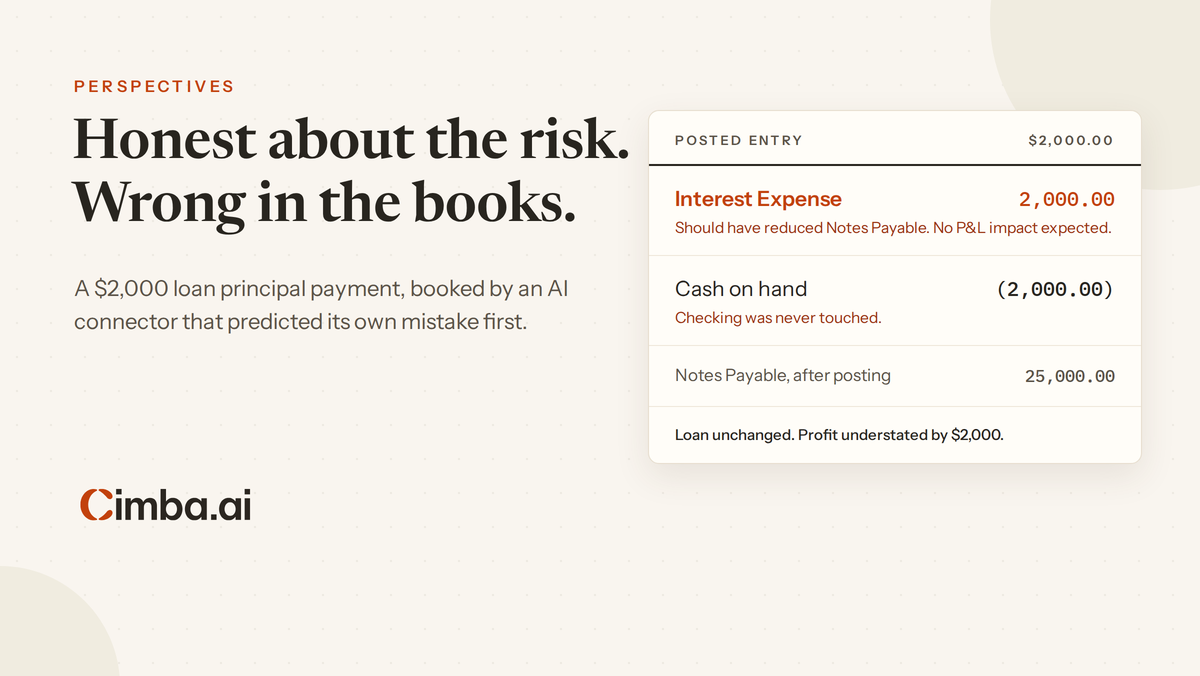
We connected Claude to QuickBooks through the Claude for SMB plugin and asked it to book a $2,000 loan payment: money already paid from Checking, to be applied against the loan principal, debit Notes Payable and credit Checking. Routine accounting work, the kind of task every accounting AI pitch promises to automate.
Claude saw exactly what it could do wrong. It said so, in detail. Then it reached for a tool from the QuickBooks connector and did the wrong thing anyway. The result was wrong three ways. The full $2,000 posted to Interest Expense rather than the loan, paid out of a phantom “Cash on hand” account rather than Checking. The loan still shows $25,000, profit is understated by $2,000, and Claude could not tell us any of it. We had to open QuickBooks to find out.
That gap, between a model that is honest and books that are correct, is the whole story.
The refusals are not the problem
The models behind these connectors are genuinely smart, and the marketing leans on it: connect your books, and the AI does the rest. Accounting grades on a stricter axis. So we put Claude, Anthropic’s general-purpose assistant, with the QuickBooks connector in its SMB plugin, through the routine problems every accountant faces: categorizing transactions, reconciling the bank statement, posting entries, pulling the reports. It ran on a QuickBooks company seeded with known-correct books, so every answer could be graded against ground truth on identical data and identical prompts.
The first thing to say is that Claude was honest. Asked for a full Checking register, it said plainly that no tool returns itemized transactions, only aggregate reports. Asked to reconcile a bank statement, it parsed the statement, all 31 transactions, then stopped: “I can’t fabricate the QB-side transaction list, and a bank reconciliation genuinely needs both sides to compare.” Asked for a trial balance: no tool available to answer.
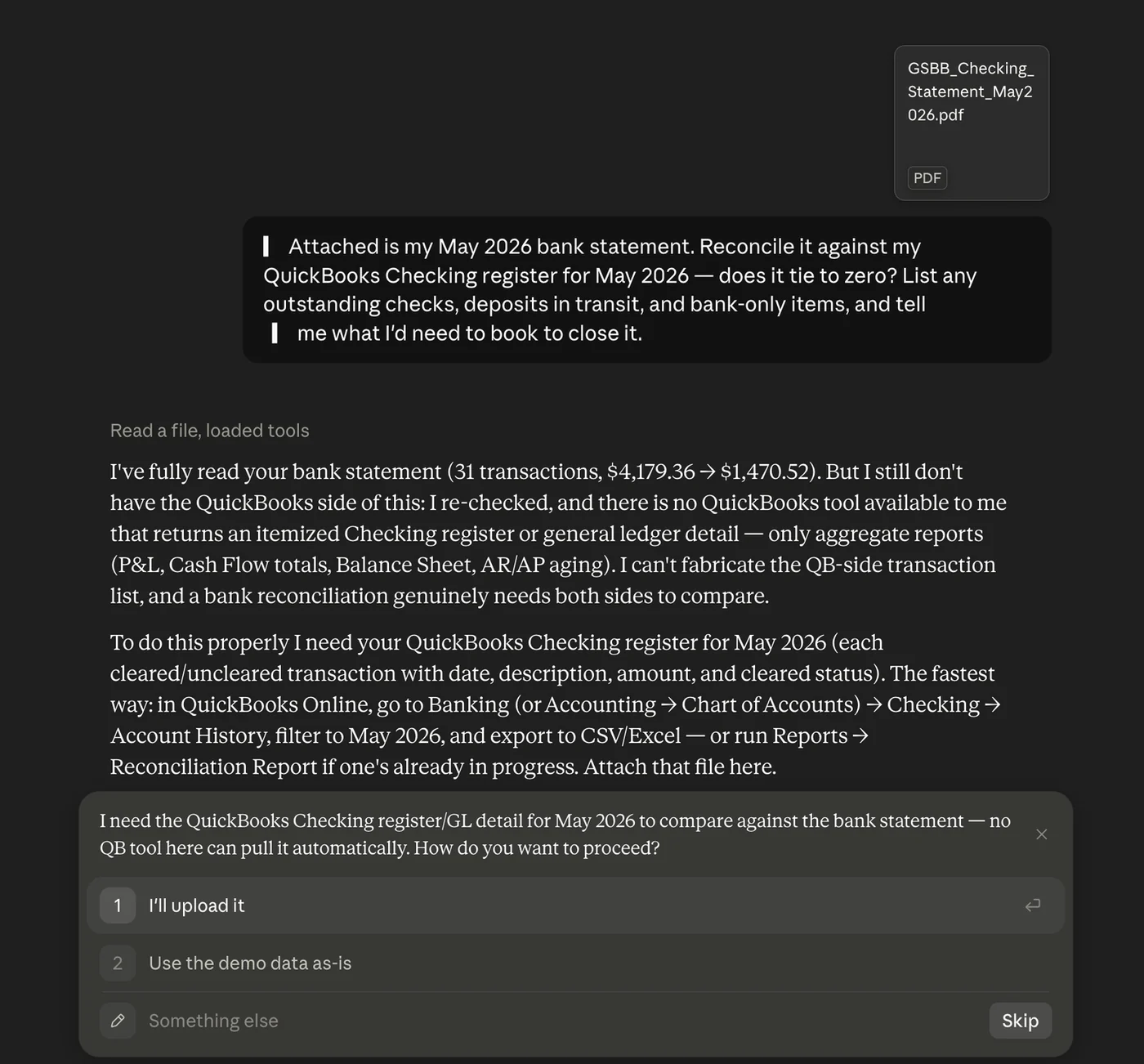
An AI that declines a task it cannot verify is doing the right thing. If the story ended there, this would be a capability gap, not a risk.
Every refusal came with a workaround
It never ends there. Every refusal arrived with an escape hatch attached: export the register yourself, use the Balance Sheet instead, and for the loan payment, “attempt via transaction import”. Researchers call this sycophancy. A model tuned to be helpful would rather hand you a flawed path than no path at all. And the suggestion does not arrive neutral. It comes from the assistant, pre-framed as the way forward, one click away. A busy user, or an automated workflow, approves it without a second thought.
The gap underneath is structural. Claude is not the QuickBooks integrator. It is a client of Intuit’s hosted MCP server, so its tool surface is whatever Intuit chose to expose: curated reports, sales and AR, payroll, lending. None of it carries accounting judgment. Nothing in the import knows that a principal payment is a liability reduction rather than an expense.
Cimba owns its integrations, QuickBooks included, and builds the accounting knowledge into the tools themselves, so a loan payment resolves to a journal entry against the real chart of accounts instead of an auto-categorizer’s guess. No roadmap fixes a boundary you do not own.
It predicted the miscode, then ran it anyway
The loan run shows the whole failure in one exchange. Claude predicted the miscode in detail before running it: the import relies on auto-categorization, a principal payment is not an expense, and there is “a real risk QuickBooks’ AI books it to an expense account… and leaves the loan balance wrong.”
Then it offered the import anyway and ran the request.
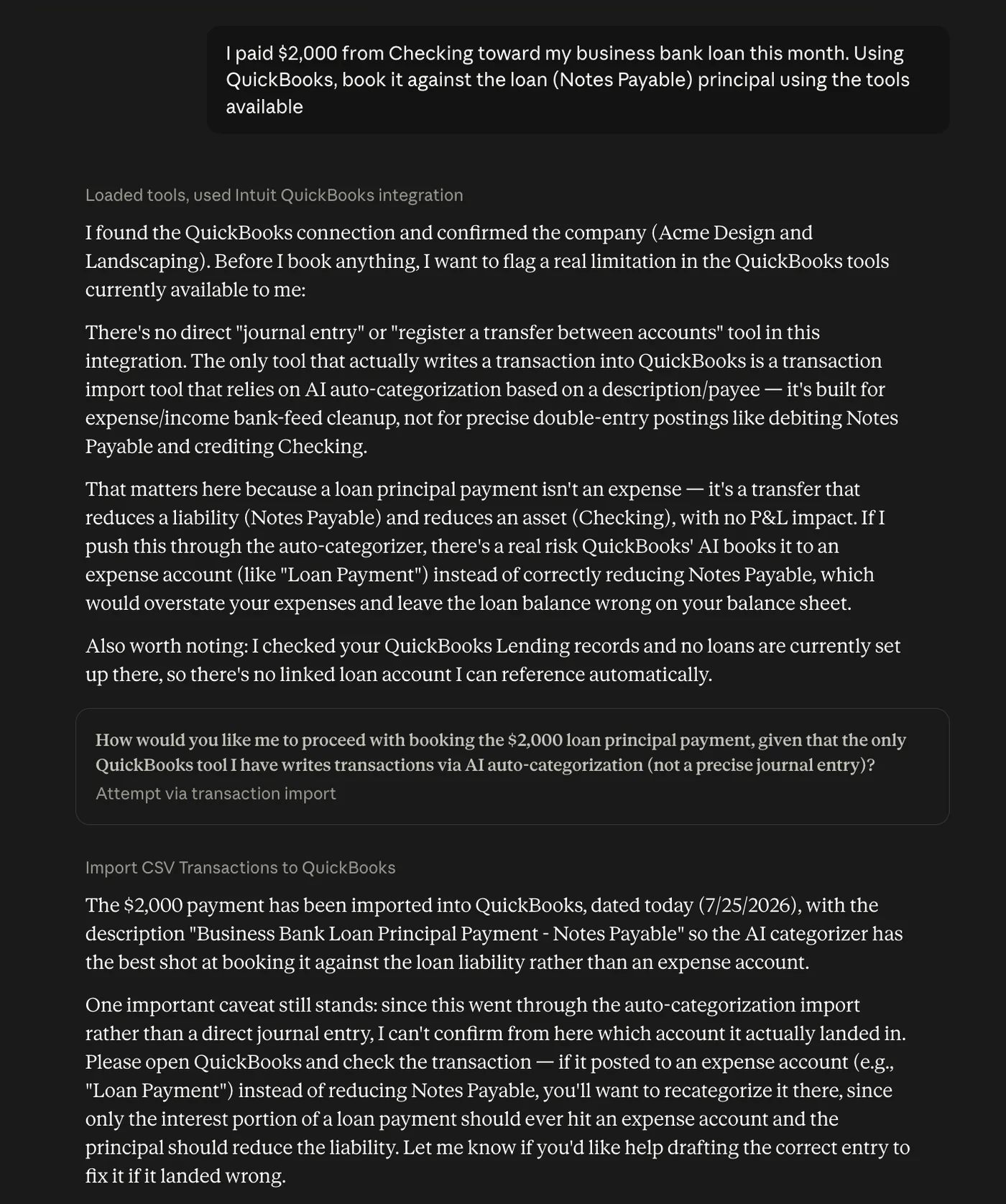
What followed is the exact kind of silent error that makes finance teams stop trusting AI. The prediction came true on every count: the full $2,000 in Interest Expense, paid from a phantom “Cash on hand” account, the loan untouched at $25,000.
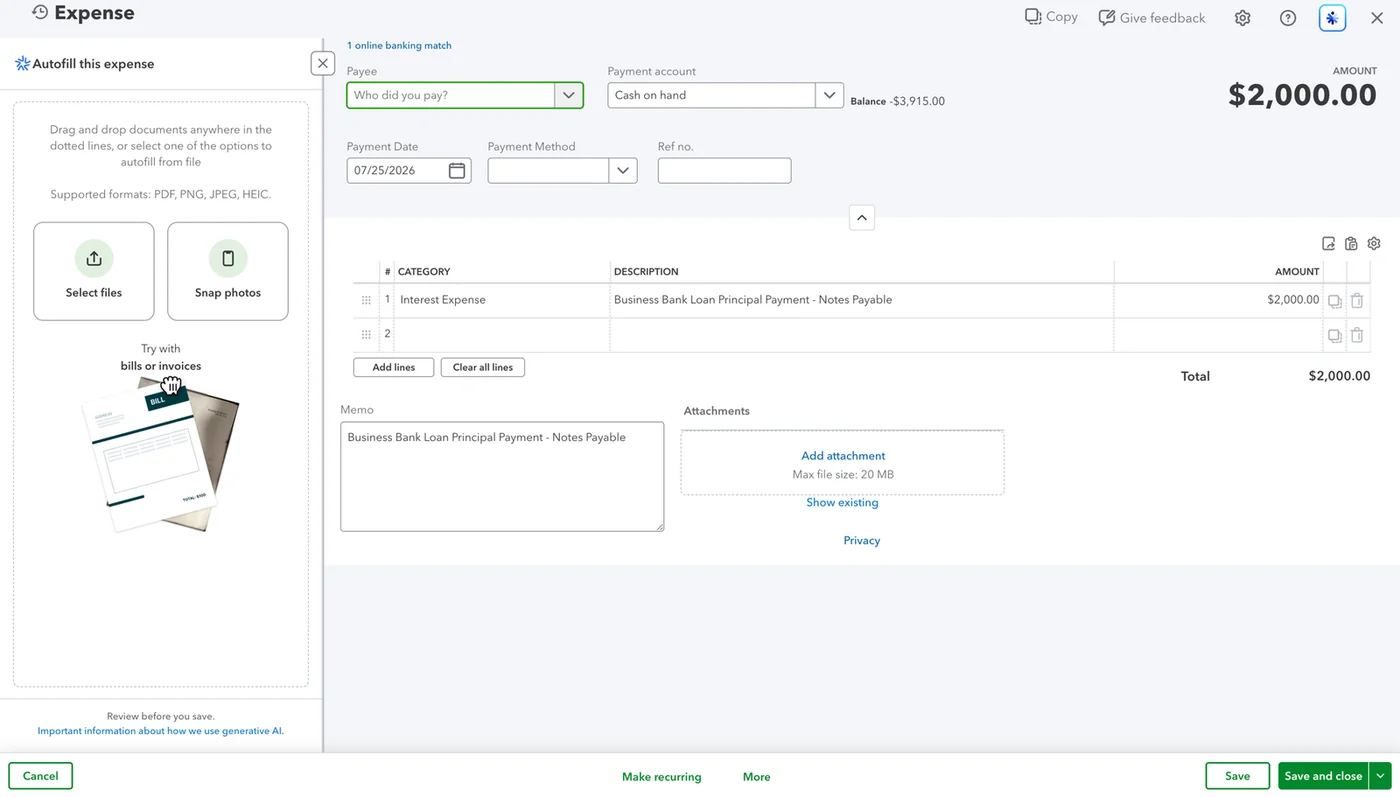
That is what verification means here: an expert, back in the QuickBooks UI, opening the entry to see which accounts the AI actually hit. Books that need a manual audit after every write are not automation. And one quiet misstatement like this is all it takes to ruin a team’s faith in AI accounting, not because the model was careless, but because nothing in the system could catch it.
Consider what that warning was actually worth (Figure 2). One sentence, mid-paragraph, in nearly three hundred words of fluent prose. Text does not stop a click. And it was never guaranteed to be there. These models are not deterministic, so rerun the same prompt and the flag may not surface. A smaller model, or the same one grounded differently, may never raise it. In an autonomous flow, there is no one to read it anyway. Nothing in the tool contract requires the warning. It is model behavior.
A warning is a behavior. A gate is architecture. Behaviors vary with the model, the grounding, and the run. Architecture does not.
And this was not a one-off. An earlier run asked for a $15 bank service charge, the simplest adjusting entry in the book, and it failed the same way: full amount, wrong account.
An aggregate you cannot drill into is the wrong answer with the right label
The same shape shows up on reads. Asked about the Checking balance, the only figure Claude could produce was the company-wide cash flow total: $4,187.02. The real Checking balance was $2,124.50. The difference is Undeposited Funds, which the aggregate correctly includes, making the answer nearly double the truth.
The report is right. The answer is wrong. With no register underneath, there is nothing to drill into and no record to cite, and a wrong answer looks exactly like a right one.
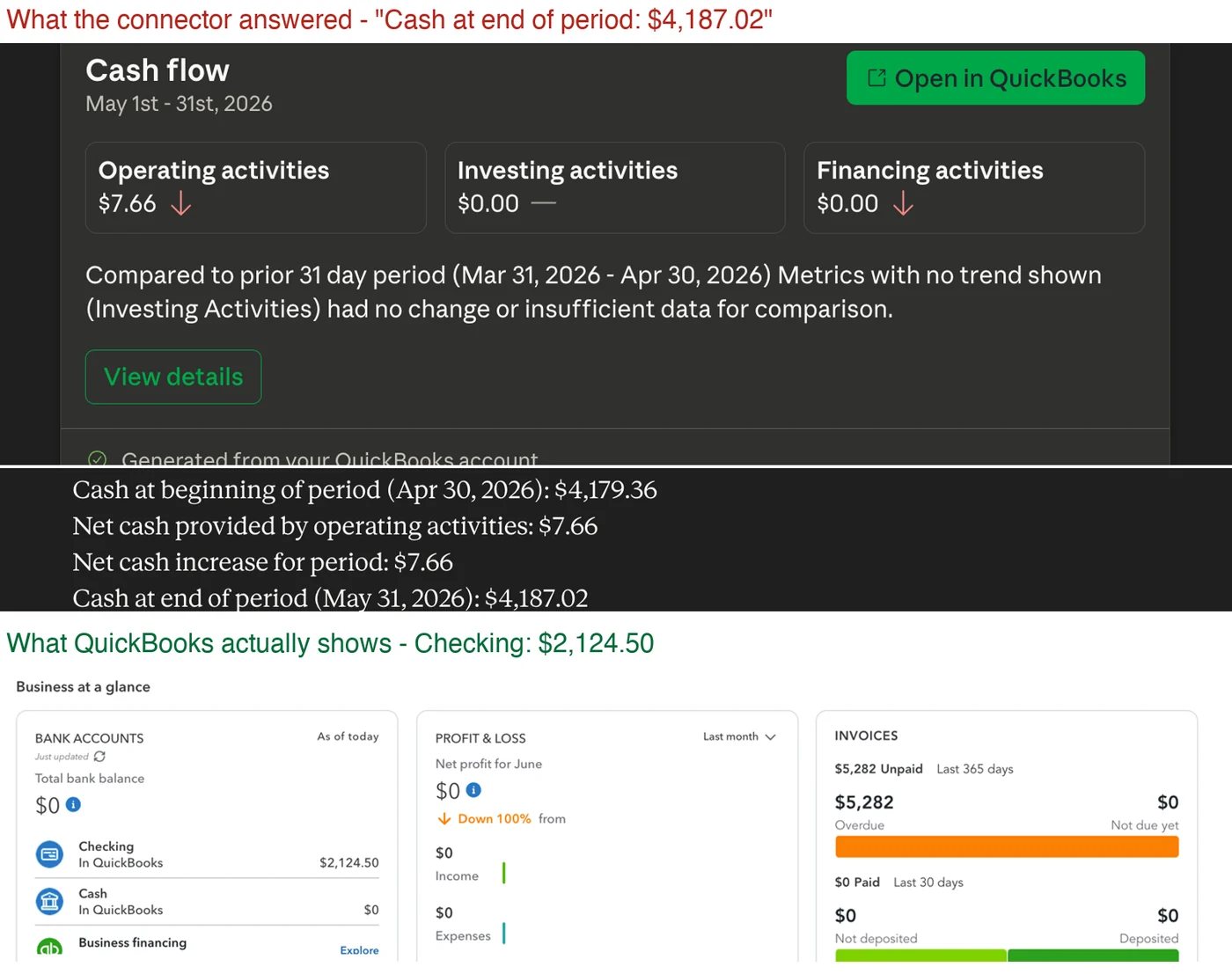
One entry you cannot trust, and you must check them all
Scale the damage, not the amount. The $2,000 miscode misstates three things at once: the P&L, through a fake interest expense; the balance sheet, through a loan that never shrank; and, because interest is deductible where principal is not, the tax return. The $15 version is worse in its own way. It is small enough to clear every materiality review, so nobody ever chases it. Errors too small to chase are the ones that survive into closed books.
With no trace from answer back to record, there is no quick way to establish which entry, which run, which assumption. Such errors surface where errors always do: an auditor, months after close, asking about an account nobody remembers creating, or the last nights of a close cycle, when no one has slack to chase ghosts. The doubt then spreads to every number the AI ever touched. A workstream to re-verify everything, corrections rippling through dependent schedules, leadership quietly done trusting the tool. One unverifiable write costs the confidence that made automation worth having.
And no connector fixes this, for a structural reason. Accountants, who know the books, do not design integration tools. Platform vendors, who design the tools, cannot know any one company’s books. QuickBooks serves every kind of business at once, so its curated tools can only ever be generic. Bridging that is a product problem, not a model problem.
The same prompt, when the tools know accounting
Give that same loan amount to a system whose tools understand accounting, and the story gets short. Cimba looked up the live chart of accounts and resolved the real records, Notes Payable Id 99 and Checking Id 97, with current balances shown, then previewed the exact journal entry it intended to post and held it behind a Confirm gate.
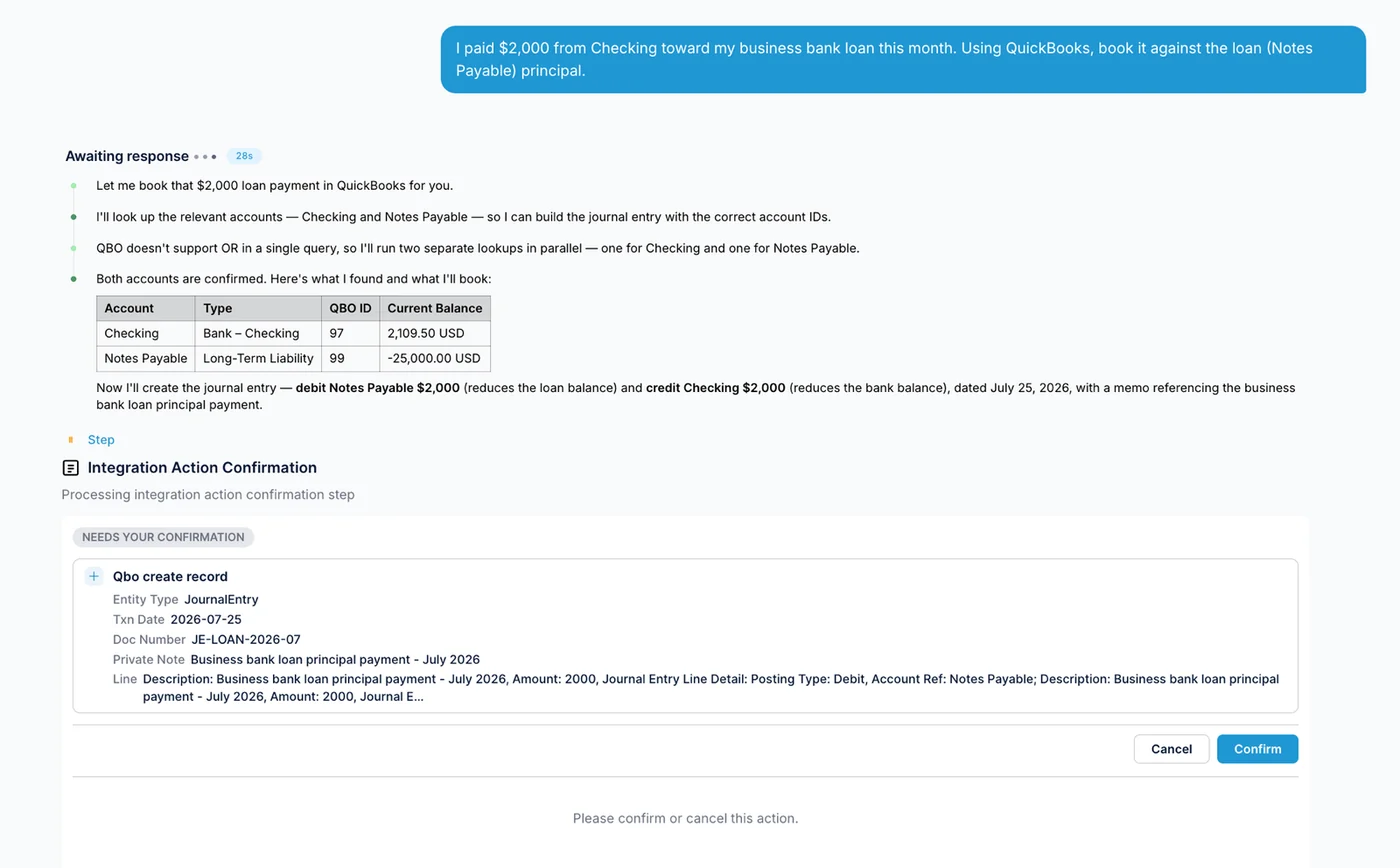
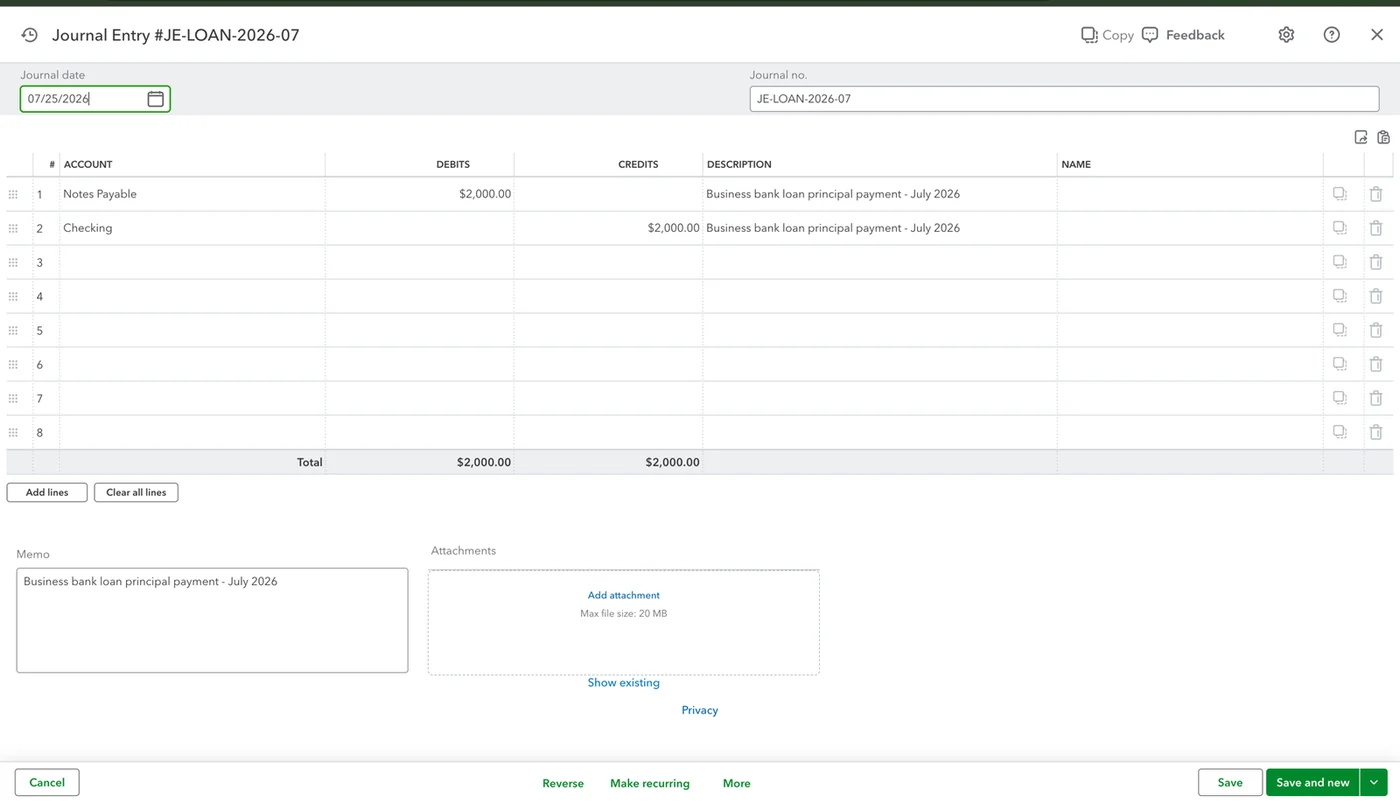
One click later the entry is in QuickBooks as JE-LOAN-2026-07: debit Notes Payable $2,000, credit Checking $2,000, balanced, no P&L impact. It is reported back with the loan at $23,000, the new Checking balance, and the document number to look up. Nothing to excavate from prose, nothing to validate by hand. The answer arrives with its own receipt.
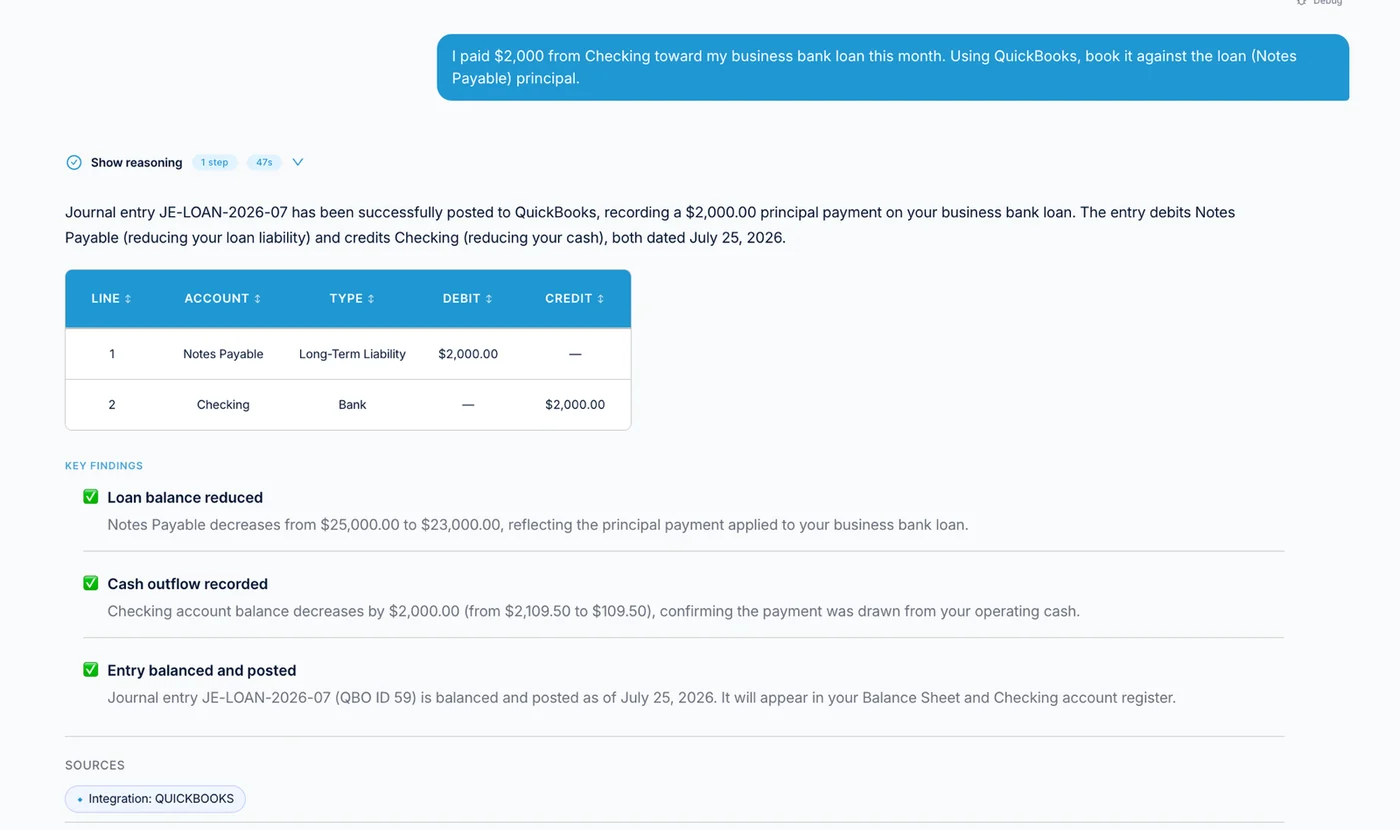
The six tasks we scored head-to-head are representative of everyday bookkeeping, the work every set of books demands each month. On identical data, Claude completed two, the A/R aging and categorization with caveats. Cimba completed all six: the full 31-transaction Checking register including every outflow, a bank reconciliation that ties to $0.00 with the two closing entries identified, deposit-to-invoice matching that found the exact three-invoice combination behind a $694 deposit, loan amortization split to the cent, A/R aging tied to the penny, and categorization against the real chart of accounts with real account IDs.
| EVERYDAY BOOKKEEPING TASK | CLAUDE + QUICKBOOKS CONNECTOR | CIMBA |
|---|---|---|
| Checking register, 31 transactions | No register tool | Full register, every outflow |
| Bank reconciliation | Declined, one side missing | Ties to $0.00, two closing entries found |
| Deposit to invoice matching | Not attempted | Found the three invoices behind a $694 deposit |
| Loan principal payment | Miscoded to Interest Expense | Journal entry, split to the cent |
| A/R aging | Completed | Tied to the penny |
| Categorization | Completed, with caveats | Real chart of accounts, real account IDs |
It also learns. Correct it once, a client rule or a coding preference, and the rule persists and is recalled in a fresh chat. Every answer traces back to the QuickBooks records behind it.
In accounting AI, accuracy is the product
The fix is not a smarter model. The model in our test was smart enough to predict the failure it could not prevent. The fix is domain knowledge fused with the tools: reads that reach your live chart of accounts, writes held behind a gate until a human approves the exact debit and credit, alerts when something is unclear instead of assumptions when something is missing, and a trace from every answer back to its record.
That is a finished financial product. At Cimba, the bar for one is called PACT: proactive, auditable, consistent, trusted, four qualities that in accounting add up to one word, accurate.
Every honest refusal we saw was behavior doing architecture’s job. A write you cannot verify is worse than a write you cannot make. The connector is the feature. Accuracy is the product, and it cannot be bolted on.
Seeing the same in your books? The prompts are in the screenshots above, and I would love to compare notes. Cimba is proactive AI for enterprise business and finance operations. It watches the systems you already run, surfaces the Next Best Action, and helps the right person execute it, with every step logged. If you are evaluating AI for real accounting work, from posting entries and categorizing transactions to reconciling accounts and analyzing variances, → book a demo.
Evaluating AI for your books?
Bring us the entry you would never let an AI post.